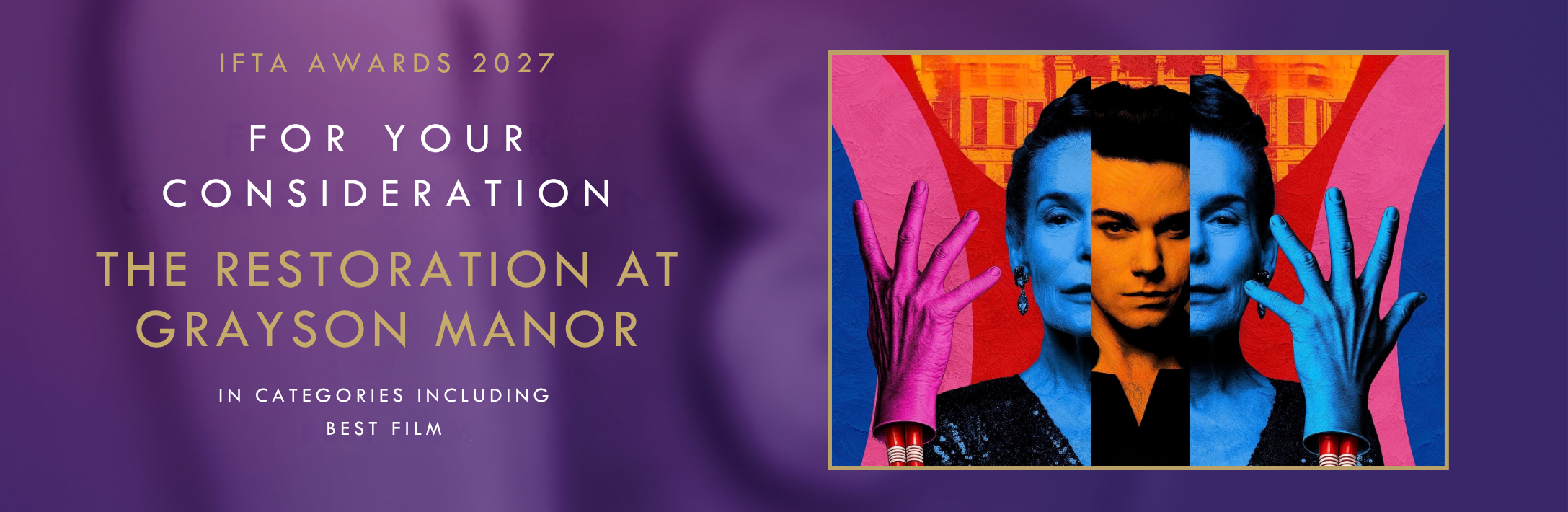
FOR YOUR CONSIDERATION
IFTA AWARDS 2027
THE RESTORATION AT GRAYSON MANOR
Boyd Grayson delights in bringing men home to his sprawling family estate for sex, taunting his legacy-obsessed mother with the cruel reminder she’ll never have the grandchildren she craves. When a freak accident leaves him handless and helpless, Jacqueline seizes the opportunity to mold him into the heir she always wanted, outfitting her son with experiment prosthetics wired directly to his subconscious, a gift that comes with a terrible cost for all who enter Grayson Manor.
Director: Glenn McQuaid
Writer: Clay McLeod Chapman & Glenn McQuaid
Cast: Chris Colfer, Alice Krige, Daniel Adegboyega, Declan Reynolds, Gabriela Garcia Vargas
FILMMAKER Q&A
A conversation with Director/Co-Writer Glenn McQuaid
Q: What was the genesis of this film, and how did it evolve over the course of development to production and completion?
"One of my earliest memories of cinema is watching The Beast with Five Fingers (1946) with my dad, and I’ve had a fondness for the severed-hand genre ever since. There’s something wonderfully primal and absurd about a hand scuttling around on its own, and the initial spark for The Restoration at Grayson Manor was simply wanting to make my own contribution to that strange little corner of horror cinema. But the film grew into something much more personal. Horror has always been a form of escape for me, and so has melodrama. Growing up, I loved soaps, and they gave me some of my first gay role models who were more than victims, or characters to be pitied, feared or mocked. They could be complicated, glamorous, difficult and defiant, and they refused to be scapegoated.
Those two influences really came together in The Restoration at Grayson Manor. Beneath the Gothic horror and the severed hands, I wanted to explore the weight of heteronormative expectations, particularly those imposed by family, tradition and generational trauma, but I wanted to give those forces a worthy opponent in the defiantly queer shoulders of my lead character, Boyd Grayson. He refuses to accept that there is anything shameful about who he is, and he’s more than delighted to chop down the family tree and its traditions once and for all. In that sense, I think there is something combative going on with the movie. I joke that it’s heterophobic because there is a defiant kickback against the worst aspects of heteronormative societies that have historically scapegoated, assaulted and murdered queer people simply for being who they were born to be. Boyd isn’t interested in asking that society for acceptance or permission. He fights back, and there was something cathartic for me in allowing him to do that.
So what began as a love letter to a wonderfully peculiar horror subgenre evolved into something much more personal: a Gothic melodrama about family expectations, identity and the sometimes bloody business of refusing to become the person society expects you to be.
There is also a very particular homosexual paranoia in the film about falling in love with a heterosexual man. We live in a world where the so-called “gay panic” defence has been used to excuse or mitigate the killing of queer people simply because they expressed desire. There is something terrifying in that: the possibility that an expression of love or desire can be dangerous, can lead to ostracism, violence or often death. In that sense, Boyd navigates those dangerous waters without giving in, in any way, shape or form, to the closet. He refuses to make himself smaller or less queer in order to protect himself from the hurt."
Q: What did you feel was the most fulfilling element of working on this film?
"The most fulfilling element for me was directing the cast on set. I loved being able to diagnose when a moment wasn’t quite ringing true and implement different techniques to breathe life back into the room. We used Meisner techniques to loosen things up and dive deeper than I think any of us thought we would, given the sometimes frivolous nature of the horror tropes we were playing with.
I loved allowing the actors to initiate the dance with the camera. I think we mined some lovely work just by seeing what felt natural to them in the space. That meant disregarding storyboards and animatics in favour of something more spontaneous. Finding those moments together with my DOP, Narayan Van Maele, was invigorating. So when I think about what was most fulfilling, it was knowing that my actors trusted me as their safety net, and seeing how fearless they became with me on set. Their fearlessness gave me a stronger sense of my own vision. We knew we could try things, go further and make ourselves vulnerable. Those were some of the most rewarding moments for me."
Q: To what extent was your on-screen talent vital to the success of the film?
"The cast was absolutely vital. Casting is finding the right people and then trusting them to take ownership of the characters. Once they do, you have to be willing to let the characters become something beyond what you originally imagined on the page. The chemistry between Chris Colfer and Alice Krige was particularly important. Boyd and Jacqueline have this incredibly barbed relationship, and it is such a fine line. Two characters sparring like that can be thrilling to watch, or they can become insufferable very quickly. Tennessee Williams was always somewhere in the back of my mind. I wanted the pleasure of watching two intelligent, damaged people who know exactly where to stick the knife, but it also had to be fun. Chris and Alice understood that balance beautifully and brought so much wit, hurt and charm to the relationship.
With Declan Reynolds, there were times when I would talk to him as his character’s best/worst friend. I wanted spontaneous, non-intellectualised work, just going on the gut instincts of the two of us, and I wouldn’t move on until I knew we’d found what was underneath the scene. Declan allowed himself to be incredibly vulnerable and honest with me on set, and that trust paved the way for a beautiful collaboration. Declan brought such soul to the work that it’s hard to imagine the film being the same without him. He found such tenderness and humanity in Lee, and brought an emotional depth to the character that became part of the heart of the film.
Gabriela Garcia Vargas gave me that same trust. Her ego-death scene could easily have tipped into broad comedy, but it was important to both of us that we took Claudia and what was happening to her completely seriously. Gabriela was extraordinarily vulnerable in that scene, and I think that honesty is what makes the extremity of it work.
And then Daniel Adegboyega brought another energy entirely to Dr. Tannock. With Daniel, there was a real pleasure in guiding the performance towards what I knew I needed while leaving him the space to interpret it for himself. We had fun finding that character's motivations together.
There’s something special about bringing together an ensemble with different training, instincts and levels of experience, and helping weave all of that into something that feels like it belongs in the same world. I loved working with all of them."
Q: What does it mean to have your work acknowledged by your peers in the Irish film community and have it showcased for consideration for the IFTA Awards?
"Growing up in Dublin in the 70s and 80s, I thought filmmaking happened in a different universe to me. I loved movies obsessively, but the idea that I might actually become a storyteller and filmmaker myself, and make work in Ireland, felt very far away. So there’s something incredibly meaningful about having The Restoration at Grayson Manor acknowledged and watched by my peers in the Irish film community. Making films is such a strange, difficult and often very personal thing to devote your life to, and to feel that your work has a place within the filmmaking culture you grew up around means a great deal to me.
I also feel very lucky to be working in Ireland at this point in my life. There’s an extraordinary amount of talent here, in front of and behind the camera, and to have this film showcased alongside the work of other Irish filmmakers for consideration by IFTA feels a little surreal to the kid who once thought all of this happened in some other universe."
68 Dame Street,
Dublin 2, Ireland.
Tel :+353 1 9053599
 |  | logomenu.png) |