
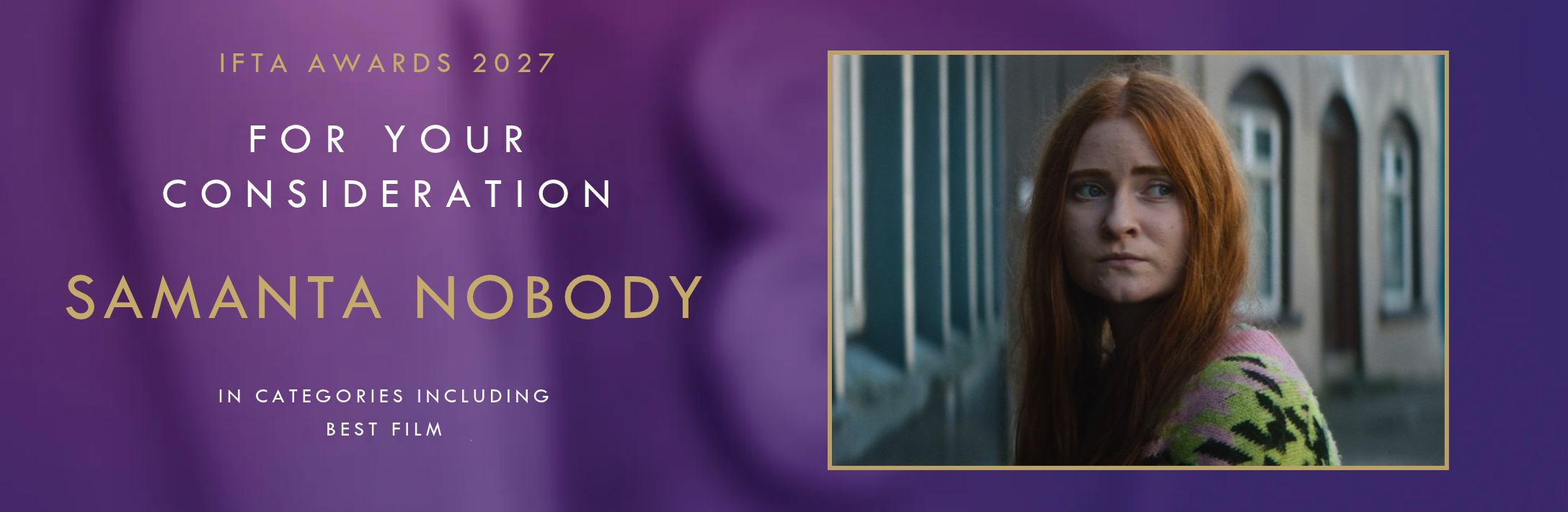
FOR YOUR CONSIDERATION
IFTA AWARDS 2027
SAMANTA NOBODY
Samanta Nobody is a moving coming-of-age drama about resilience, identity and the transformative power of music, a poignant reminder that our past may shape us, but it does not have to define you.
Writer/Director: Ciaran Creagh
Cast: Ruby Jean Lennon, Brendan Conroy, Maggie Hannon, Declan Drohan & Conor Hamill
FILMMAKER Q&A
A conversation with Director, Ciaran Creagh
Q: What was the genesis of this film, and how did it evolve over the course of development to production and completion?
"Samanta Nobody was a project that evolved over the course of almost a decade, passing through numerous drafts and creative developments before reaching its final form. At its inception, I was interested in exploring the experience of a young teenager forced to live on the streets but still finding their place in the world, where vulnerability and isolation can be particularly profound.
However, prior to shooting, my perspective on the film shifted significantly. I began to see the story less as an examination of survival and more as one of renewal. I wanted to place Samanta’s character, her abilities and her inner strength at the heart of the narrative. What if, despite circumstances beyond her control that had left her homeless, she possessed an extraordinary gift for singing and composing music? Living on the streets, exposed to the world yet largely unseen as a person, music becomes her private refuge. She creates and performs for herself, keeping her talent hidden from public view.
The film ultimately follows Samanta’s journey from this place of isolation towards the courage to share her music with others and become a busker. At its heart, Samanta Nobody explores the transformative power of creativity: how music can offer more than comfort or escape, becoming a means of rediscovering oneself, reclaiming a sense of identity and, ultimately, finding a reason to live."
Q: What did you feel was the most fulfilling element of working on this film?
"There are so many to mention, but the main two are music and Sligo. This is my second film to shoot in the west. We shot Ann in Boyle, Co. Roscommon, and Samanta Nobody in Sligo town and Rosses Point. There is a different vibe when you shoot here in the west. I think the main reason is that the people genuinely want to help and really appreciate the fact that you have chosen their area to set your film. Nothing is a problem, whereas in big cities that you may shoot in, everything is an issue. Having that sort of assistance and welcome is very refreshing and helpful.
Sligo is such a beautiful town. It has changed so much from what I remember it was. From a cinematic perspective, it looks really interesting and has so much to offer. It has everything you could possibly need.
One of the great joys of making Samanta Nobody was discovering how music could become such an integral part of the storytelling. When Roger Taylor first read the screenplay, we began talking about Samanta herself: her vulnerabilities, her strengths, and the emotions she carries beneath the surface. Those conversations became the starting point for developing the film’s musical identity.
We decided early on that the acoustic guitar would be Samanta’s instrument. It made sense for practical reasons within the story: it was something she could realistically afford, carry with her, and take from place to place as she moved through life on the streets. But the decision also came from observing the world around us. Spend time watching buskers and you quickly realise that so many are singer-songwriters, with the guitar their natural instrument of expression. It felt entirely right for Samanta.
From that simple decision, the songs began to take shape. The acoustic guitar became the foundation for tracks such as Mary Ann, Someday, Every Time and Broken Stone, each developing organically from the character and the world she inhabits. We also wanted the lyrics to feel inseparable from the film, reflecting Samanta’s experiences, her emotional landscape and the people she encounters. Roger achieved something particularly special here: he captured the voice of a sixteen-year-old girl with a remarkable degree of authenticity and sensitivity. When you listen to the songs, you hear Samanta’s life unfolding through the lyrics.
It was a wonderfully rewarding process to see music evolve from being one element of the screenplay into something that could express what Samanta herself often cannot put into words. The songs give us access to her inner world, allowing the audience to understand her in a different way. For me, that was the real pleasure of bringing music into the film: it became not simply a soundtrack to Samanta’s journey, but an essential part of telling her story."
Q: To what extent was your on-screen talent vital to the success of the film?
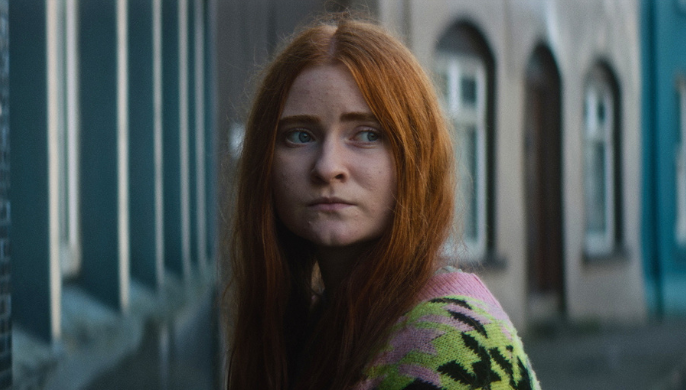
"One word: key! The actors were absolutely central to the success of Samanta Nobody, because the film depended on the audience forming a genuine emotional connection with its characters. At the heart of the story is a sixteen-year-old girl whose circumstances might easily define her in the eyes of others, but whose inner life, intelligence, vulnerability and creative ability reveal a much more complex person. Finding an actor capable of conveying these different layers with honesty and sensitivity was essential. The performance needed to feel natural and unforced, allowing Samanta’s resilience and fragility to exist side by side without ever slipping into sentimentality. Much of the storytelling rests on what remains unspoken, so the ability to communicate through expression, gesture and silence was just as important as the dialogue itself.
Ruby Jean Lennon was an eye-opener, to be honest. She has so much natural ability, was on the money every take and so professional on the shoot at just sixteen. Added to that were Maggie Hannon and, of course, the great Brendan Conroy. How lucky were we?"
Q: What does it mean to have your work acknowledged by your peers in the Irish film community and have it showcased for consideration for the IFTA Awards?
"It is always gratifying to have your work recognised by people within the Irish film community, because they understand the challenges, commitment and collaboration involved in bringing a film to the screen. Samanta Nobody was a project that took many years to develop, and it means a great deal to see the work of the cast and crew acknowledged in this way.
Having the film considered for the IFTA Awards is also an opportunity to bring it to the attention of a wider audience. Filmmaking is a collective effort, and any recognition belongs to everyone who contributed their talent and energy to the production. Ultimately, the greatest satisfaction is in making a film that connects with people, and it is encouraging to feel that Samanta Nobody has the opportunity to do just that"


logomenu.png)