
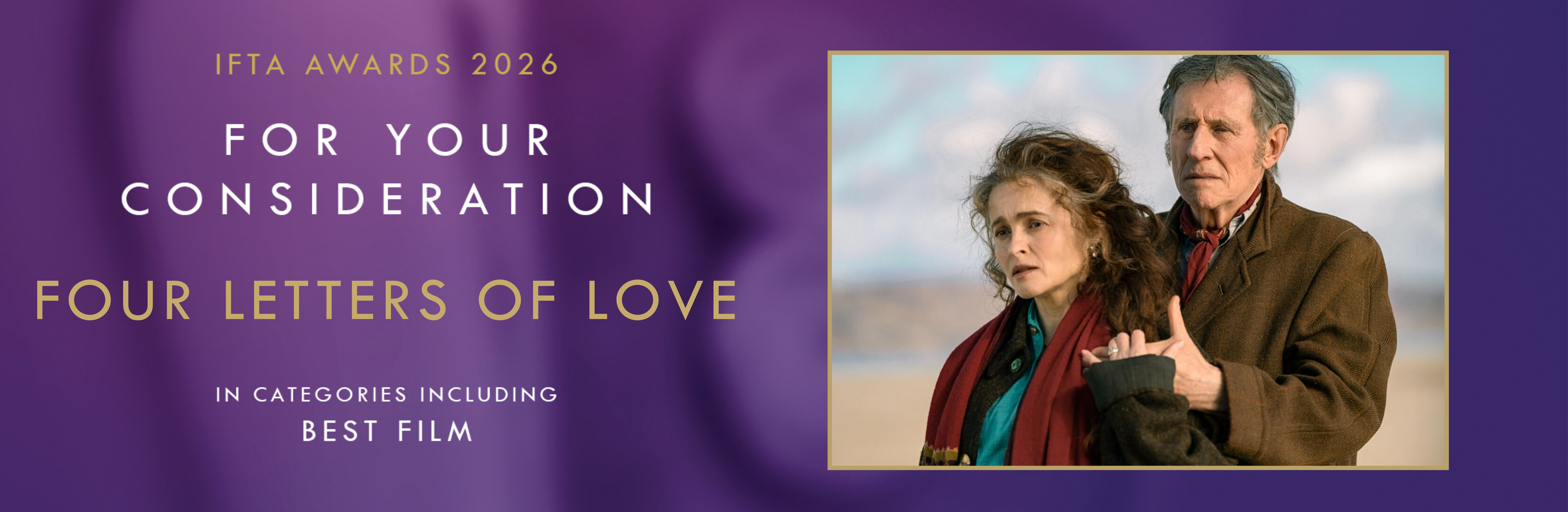
FOR YOUR CONSIDERATION
IFTA AWARDS 2026
Four Letters of Love
Based on Niall Williams' best-selling novel. Nicholas and Isabel were made for each other but how will they ever know it? As ghosts, fate and the sheer power of true love pull them together, so too does life threaten to tear them apart.
Director: Polly Steele Writer: Niall Williams Producers: Douglas Cummins, Debbie Gray
Filmmaker Q&A
Q: What was the genesis of this film, and how did it evolve over the course of development to production and completion?
Niall Williams (Author): “One day I woke with a first sentence. ‘When I was 12 years old God spoke to my father for the first time.’ I had no idea what God said or what happened next. I went to a room in the cottage here and wrote that sentence every day for weeks. I knew it was the beginning of something, but what? I guess that in the end what counted was that I believed the story was out there, or in there, and that if I kept showing up I would find my way to it. I knew I wanted to write about love, thought I would only get one chance to say all I could about every kind of love, between fathers and daughters, mothers and daughters, sisters and brothers, husband and wife, lovers, what Edna O Brien eventually called ‘a mosaic of loves,’ and that all I had to do was stay in the chair. The novel was published in 1997, and in all the years since then it has always been the subject of talk about becoming a film. Very many people and from as many countries have told me they have ‘seen’ the film, and many believed they were the ones to make it. Because it is such a personal novel, and maybe as peculiar as myself, I always thought that if it happened, I would have to attempt the adaptation myself. To that end I began to study as many scripts as I could and learn the very different discipline of screen writing. I found the challenges and the restrictions refreshing, for your imagination rises where it meets walls, and How do we make this work? has an added zing when you know that the scene is actually going to be shot, with these lines and these extraordinary actors. In the novel the character of Nicholas is 12 on the day his father comes home from the Civil Service and says God wants him to be a painter. A longer timeframe is in the novel. For the film this needed to be condensed and concentrated. It gives the first section of the film a charged intensity. As with the novel we move back and forth between the Urban and Rural stories, between the male one and the female one, between the one where God arrived and the one where he departed, but in the film the choices of when we cut from to the other are sometimes different, as the rhythm of the story dictates. Overall, I think the film very accurately captures the feeling of the novel."
Q: What did you feel was the most fulfilling element of working on this film?
Niall: “There were many fulfilling elements. But, having worked on my own as a novelist for the best part of forty years, perhaps foremost was the fact of working with others to a single goal, from Polly Steele, the director, through the remarkable cast and full creative team on the shoot, right through to post-production and final song. No film belongs to one person, and this was a new experience for me."
Q: To what extent was your on-screen talent vital to the success of the film?
Debbie Gray (Producer): “Our on-screen talent was vital to the success of the film. Both from a creative standpoint but also on a commercial level so there is always a balancing act to consider when casting. Fortunately for us there was an enormous amount of existing love and support of Niall’s novel and then script which enabled us to attach a fantastic cast."
Q: What does it mean to have your work acknowledged by your peers in the Irish film community and showcased at the IFTA Awards?
Niall: “As someone who, first, by nature, and then by choice, and circumstance, has always been an outsider, it means a great deal to have the work acknowledged by the Irish film community."


logomenu.png)