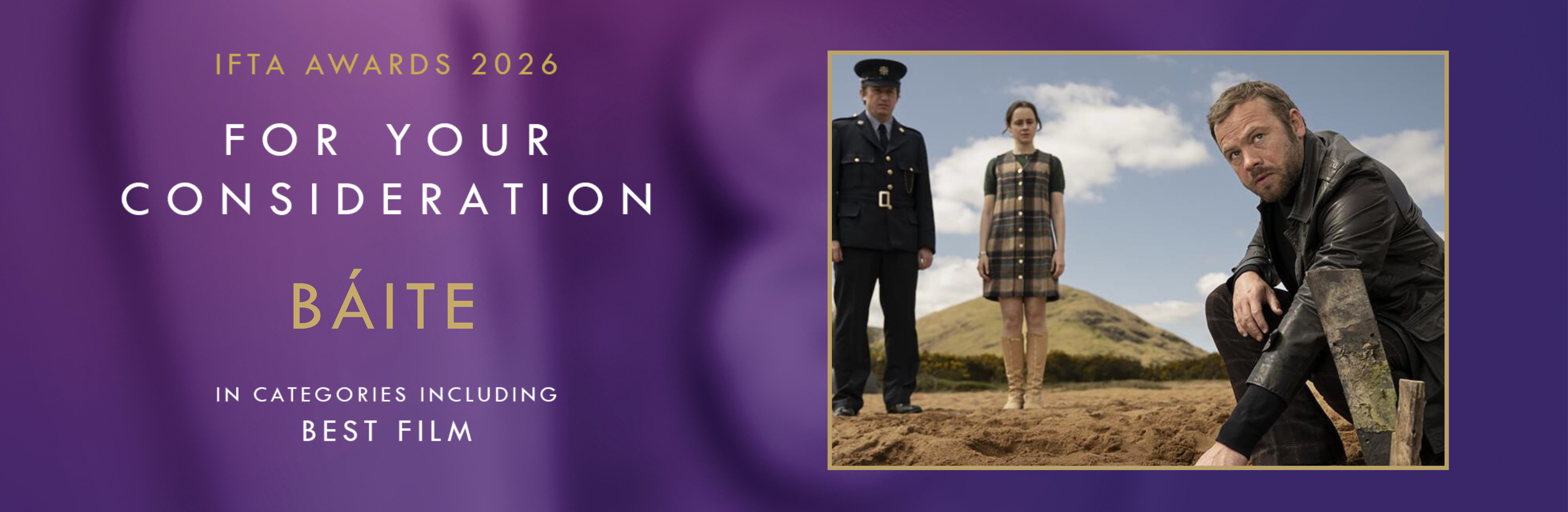
FOR YOUR CONSIDERATION
IFTA AWARDS 2026
Baite
September 1975. Peggy Casey prepares for a big weekend of fishing. Her pub will be full to the door, and she desperately needs the business. When a body is found in the receding waters of a nearby lake, the discovery becomes big news in the locale. Detective Ryan is sent from Dublin, and what he discovers sheds a disturbing insight into the history of the valley and the Casey Family.
Director: Ruán Magan Writer: Sheena Lambert Producers: John Brady, Siobhan Ní Ghadhra
Filmmaker Q&A
Q: What was the genesis of this film, and how did it evolve over the course of development to production and completion?
Siobhán Ní Ghadhra & John Brady (Producers): "Sheena first approached us with a TV adaptation in English based on her book, The Lake. As we got to know Sheena and discussed it more, we then decided that it would be perfect for Cine4. The process was really interesting and Sheena was great to work with. We had lots of discussion and back and forth and also great input from Ruán, The Director and also our execs in Screen Ireland and TG4. We loved the story, the setting, the characters and seeing it come to life on screen is such an amazing experience. It’s a great story, looks amazing and we’re really really proud of the film."
Sheena Lambert (Writer): “The Báite screenplay is an adaptation of my novel The Lake which was published by HarperCollins in 2015. I had wanted to write about people whose lives were uprooted by the flooding of rural valleys in the 1950s - something that was happening all over the world at that time. The echoes of bitterness and loss that surrounds the manmade lakes, and the people of the drowned villages within them, was rich with potential story for me. The novel was written from the points of view of Peggy Casey, a young local publican and Frank Ryan, a city Guard, but it is Peggy's story that naturally came to the fore during the process of adaptation for screen. Finding the story of the film within the novel was a wonderfully fulfilling process and the fact that my novel was written in English and the screenplay in Irish was a huge part of shaping the world on screen. While the novel and the film tell the same story, each leans into the natural strengths of its own medium, adding to the canon of Irish storytelling in a very gratifying way."
Jennifer Bowman (Hair & Makeup): "The film began as a book written by Sheena Lambert, which was later adapted into a screenplay. When speaking with Sheena, she mentioned that transforming the novel into a script was initially a challenge, but she handled it so beautifully. Seeing how her story evolved once the cast came on board and all the departments contributed really brought it to life. Even during filming, it was clear how special it was becoming. But seeing the final edit and grade—combined with the stunning drone shots and the beautiful coverage of Connemara—truly elevated it into a cinematic piece. The evolution from book to script, to production, and finally to the finished film felt incredibly cohesive and rewarding to witness."
Q: What did you feel was the most fulfilling element of working on this film?
Eleanor O'Brien (Actor): “It was incredible to work in the beautiful landscape of Connemara. The place itself brought such atmosphere and inspiration, and being surrounded by the Irish language every day made the experience even more meaningful. I felt very supported by the cast and crew, and it was a joy to work with people I had collaborated with before as well as to form new relationships with talented Irish creators.”
Siobhán & John: "The collaborative nature of it. Our cast and crew were amazing, every single one of them. Everyone gave it 100% and even though some elements were challenging from a production perspective, it was probably one of the best experiences of our careers. And then to have such a beautiful film at the end of it was obviously the icing on the cake so to speak."
Pádraig Ó Loingsigh (Actor): Báite was about collective creativity and the most fulfilling element for me was the way we worked as an ensemble to create the community in the village and in particular the generational relationships between the characters. The memory of the lake's creation and the village drowned in it somehow became a thing in itself - a living memory, like a lost language that outsiders don't really understand - the production crew and the creatives seemed to understand that and quietly helped us ( the cast) to create that unspoken atmosphere which is, for me , the essence of the story.
Fionnuala Gygax (Actor): "Getting to immerse myself in a different time period and having the opportunity to work through the Irish language."
Juliette Crosbie (Actor): “Probably the chance to make a feature film, as Gaeilge, in Irish... Its hugely important that as an industry, we continue to write and create stories that use our national language and encourage our heritage to live on. I’m immensely proud to have played a part in that sense. But also, its such a moving story. It spans decades and features so many strong, vulnerable, intelligent women who I know everyone can recognise and love. Its got so much heart, from start to finish. That’s a huge privilege.”
John Murphy (Editor): "Working with Ruán, Sheena and the team at Danú Media was a great experience. Being able to make films as Gaeilge in the West of Ireland is a true privilege."
Gemma Keenan (Costume Design):
"The most fulfilling element of working on Báite was the sense that we were all unconsciously called to this story. As creative leads, our visions seemed to recognise one another instantly, intertwining in a way that felt immensely instinctive. For me, as a lover of period work, it was especially rewarding to shape the film’s emotional past through costume. To let fabric, silhouette, colour and texture hold the echoes of a world half lost to memory. Watching actors step into these costumes and feel the weight of their characters’ histories was a deeply gratifying part of the process. There was a raw harmony in how my perceptions and designs aligned with Ruán’s hauntingly beautiful vision and I loved seeing how costume became a bridge between character and landscape, carrying the same quiet melancholy and beauty that define the film. At heart, the fulfilment came from witnessing how our shared instincts brought Báite to life."
Q: To what extent was your on-screen talent vital to the success of the film?
Eleanor: “My job was to honour the character and support the story, and I’m proud of the part I played in bringing it to life. I also genuinely loved creating this character and exploring their world. At the same time, the film truly comes to life through the collective talent of everyone involved. The writing, the direction, the cast, the Irish language itself, and the cinematography, especially the way it captures the stunning Connemara landscape, all worked together to create something bigger than any single performance."
Pádraig: "I was so happy to be working on a film in the Irish language because I was able to draw on deep memories of people and experiences, and to create a character called 'Coleman Devitt' who chanalled them. Coleman was a composite of so many uniquely Irish elements and in a way was formed by the language: talent, for me anyway, is being able to - beg,borrow and steal from the nebulous past and create a life on screen based on a real experiences."
Jennifer: “I think the casting on this film was absolutely vital to how the final movie turned out. I honestly couldn’t imagine these characters being played by anyone else. Each actor brought so much depth, emotion, and presence to their role, and it was evident even while we were filming just how powerfully they were interpreting the script. They were all a dream to work with—professional, patient, and genuinely committed to doing whatever was needed hair- and makeup-wise to enhance their characters. Whether it was haircuts or makeup looks that weren’t always the most comfortable to wear day to day, they embraced everything with such grace and dedication. The atmosphere on set really mirrored the sense of family in the script. Both cast and crew worked together so cohesively, and I truly believe that harmony shows on screen. Their talent was not just important—it was essential to the film’s overall success.”
Q: What does it mean to have your work acknowledged by your peers in the Irish film community and showcased at the IFTA Awards?
Sheena: “As a novelist and playwright, to have my screenwriting acknowledged and enjoyed by my screenwriting peers is hugely gratifying. Being part of what is such a celebrated aspect of Irish culture is a wonderful feeling, agus cinnte is rud an-speisíalta é bheith le haghaidh mo chuid scríobhnóireachta trí mheán na Gaeilge."
Eleanor: "Being acknowledged by my peers in the Irish film community and having the work showcased at the IFTA Awards means an enormous amount to me. It’s incredibly humbling to be recognised by people whose talent, dedication, and craft I admire so much. The Irish film community is small but fiercely creative, and to know that this project and the work we all put into it, resonated with them is really special. It’s both an honour and a huge encouragement to continue telling Irish stories with the same passion and commitment."
Pádraig: “It is an exceptional honor and a vital acknowledgement - I have been working as an actor for decades and to have my work acknowledged by my peers feels like a vindication - actors' can't just hang on. We have to stay on top of our game to remain castable and relevant and having your work acknowledged by your community is huge for your moral and self esteem - the life blood of your profession. ”
Juliette:
"It’s a huge honour to be acknowledged by the IFTA awards. They are one of the most vital awards recognising work and talent in our industry, but they also champion authentic choices in rewarding excellence and legacy in this work."
Conor Dennison (Production Design): "As I keep saying, when anyone listens to me, no one person ever carries a project on their own. It takes an entire Art Departement team to make it work, with each member carrying more than their fair share. I hope this project will help showcase the many talents of the entire Art team on the project, from Props to Set Building to the ever brilliant Graphics team. With the benefit of a little hindsight, I think we've managed to pull off a really interesting job, from a really interesting era."
Noreen Bingham (Production Design): “Having your work acknowledged by peers in the Irish film community, as with Báite, signifies recognition of artistic merit, storytelling, and cultural contribution. For a film in the Irish language, this acknowledgment affirms the power of preserving and promoting the language through cinema. Peer recognition validated the creative choices of the cast and crew, particularly in navigating nuanced performances and authentic period setting. It enhances professional credibility, encourages future projects, and fosters connections within the Irish film industry. Showcasing as forums like the IFTA Awards amplifies visibility, honours collaborative effort, and underscores the value of contributing meaningfully to Ireland's cinematic heritage.”
Craig Stuart Garfinkle, Eimear Noone (Composers): "Eimear and I, as composers for film; we work in a vacuum - staring at screens and writing music. We always come in late, after the cast has had their fun. By the time the score has been written, we know the cast intimately as we have been staring at them for months, but they do not know us at all. It’s only at events like the IFTA’s that we get to meet the rest of the team and share our experience and love for the film. Finally, as composers for media, we send our music out into the world to a silent response. Unlike a concert where you get instant audience feedback, there is no applause, no standing ovation. It feels a bit unnerving. One always wonders how the music is perceived. We wonder if the art is effective. And then we get that occasional IFTA nomination and for a while, the art is validated and it feels like a standing ovation. That value is beyond measure as is the recognition by our peers."
Siobhán &
John: "We’re delighted to have been in a position to submit our film to IFTA – and it would mean so much to be recognised by our peers in the industry. There are such fantastic films in the running and we are honoured to be amongst them, especially as an Irish Language film."


logomenu.png)