FOR YOUR CONSIDERATION
IFTA AWARDS 2027
ANCESTORS
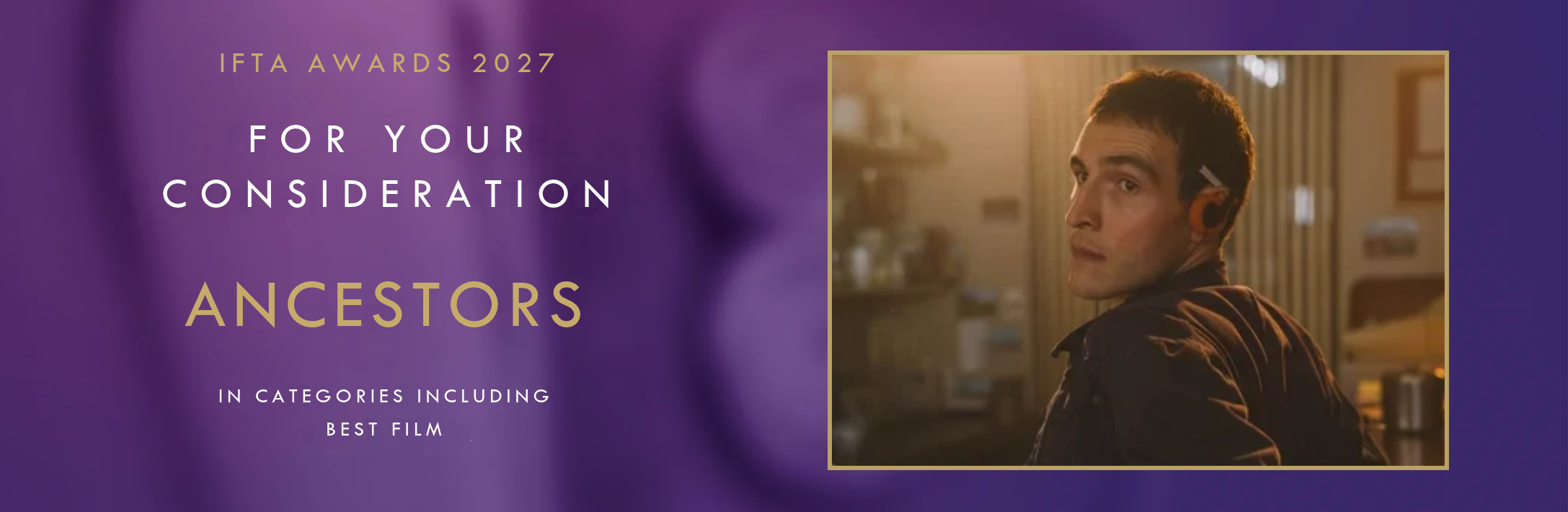
A love story, noir mystery and metaphysical fable, Ancestors follows charismatic but vulnerable Beau (Éanna Hardwicke), as he searches 1980s London for his missing friend, Tiny (Jack Wolfe). Dream, reality, memory and history entwine, ultimately bringing Beau face-to-face with life, death and the beyond.
Writer/Director: David Turpin
Cast: Éanna Hardwicke, Jack Wolfe, Jessica Reynolds, Rupert Everett, & Christina Hendricks
FILMMAKER Q&A
A conversation with the Writer/Director, David Turpin
Q: What was the genesis of this film, and how did it evolve over the course of development to production and completion?
"In a way, it's hard for me to trace the genesis of Ancestors, because so much of this film is about trying to reach back to a generation of gay ancestors, whom I never got to know in life. However much the world has changed, and in many ways improved, I think a lot of LGBT+ people feel a sense of absence, and this film is about trying to make that absence visible. I know it sounds loopy, but I feel these characters were born before I was, and I'm trying to tune in to them.
Bits and pieces of Ancestors have been in my head for as long as I can remember, but I sat down and wrote it end-to-end as a screenplay during the first lockdown in spring 2020, when it seemed like the world might end. I just thought I'd write the film I'd make if there was no judgment, no obstruction, and probably no world to make it in. Then the world didn't end, and I was fortunate that this script I'd written with no expectation was embraced by the film's producers, by Screen Ireland, by the cast, and ultimately by the many, many people it takes to make a film.
I really believe a film is a living thing. You have to hold fast to the original intention, and let that guide you through all the changes you can control and those you cannot. I hope I've been able to do that with Ancestors."
Q: What did you feel was the most fulfilling element of working on this film?
"I think the mere fact of making this film, day by day, was its own reward. It's never easy to make a film happen, but this one was a challenge. There aren't a lot of people lining up to allow a first-time director to make a poetic mystery about AIDS, which is another reason why the support of Screen Ireland, RTÉ, Northern Ireland Screen and our other contributors was so important, and never taken for granted. Films like Ancestors couldn't exist without that kind of support.
Personally, working with the cast was hugely fulfilling for me. I've been a screenwriter for many years, which can be quite insulated, so to be able to work with the actors this time was a great joy to me."
Q: To what extent was your on-screen talent vital to the success of the film?
"It's their film. A film is an act of imaginative empathy: the cast put their talent, their intelligence, their bodies and their souls to the service of imagining other lives, so that we as viewers can also imagine what it's like to live lives other than our own. I don't believe anybody could look at what Éanna, Jack and Jessica do in this film and feel they didn't rise to that.
The heroes of this film are facing the unknown, unprepared. They don't know how to give love or how to receive it, but it's there and in the end it's all they have. Éanna, Jack and Jessica connected to that. They brought so much courage and empathy to Ancestors, and they lifted these people beyond what was on the page.
I'm also very proud of the briefer performances in the film, by Irish actors like Tony Flynn, Teddy Moore, Adam Lunnon-Collery, Mark O'Halloran and Jaime Nanci. Much of Ancestors is about fragments, and they were able to make those fragments shine."
Q: What does it mean to have your work acknowledged by your peers in the Irish film community and have it showcased for consideration for the IFTA Awards?
"I think I am still getting used to the feeling of Ancestors being seen and understood. It means a huge amount to me that the Irish film community has been so supportive of it, and that it's now being considered for the IFTA Awards. I never imagined any of that when I was writing it first.
Making a film like this can be very vulnerable. You're holding out your heart to other people, with no guarantee of being understood, and saying: "I hope this will mean something to you". All you can ask is that people will reflect that care back to you. When I feel that happen, I feel less alone in this world, and I suppose my hope for the film is that it, too, will help some people feel less alone."


logomenu.png)